


Count Doubles. That’s the Game


Compounding is one of the most important ideas in investing.
Here is how it’s usually explained:
A = P (1 + R)^T
where A is the final amount, P is the initial amount, R is the return, and T is time.
While there’s nothing wrong with the formula, it's insanely hard to mentally calculate or guess what the outcomes can look over time. You almost always need a calculator!
And that's the problem.
It stays abstract!
You can’t visualise it. You can’t feel it.
It stays as a neat, theoretical concept. Not something you actually use to change your behaviour or your life.
The Better Lens: Doubling
Instead of thinking in percentages, think in doubles.
Because doubling is simple. You don’t need a calculator. You can actually picture what’s happening.
And that makes a big difference.
Why Doubling is Easy to Underestimate
The human mind is wired for linear thinking.
Drive at 50 km per hour for 5 hours → 250 km.
Another 5 hours → 500 km
Steady. Predictable.
Effort goes up. Output goes up proportionally. That’s how most of life works.
But doubling (read as compounding) doesn’t work like that.
Let us understand this better with something that is non-linear - viral videos!
One person shares a video with 2 people. Those 2 share with 2 each → 4. Those 4 share with 2 each → 8 and so on...
2 → 4 → 8 → 16 → 32 → 64…
At first, it doesn’t look like much. It feels slow. Almost insignificant.
But keep going.
- 10 rounds → ~1,000 people
- 20 rounds → ~10 lakh people
Still seems manageable.
Then you get to 30 rounds.
And suddenly you’re at 100 crore+ views.
Nothing changed in the process.
Same action. Repeated.
Only the number of rounds increased.
That’s how doubling (read as exponential growth) works.
It looks small for a long time. And then it doesn’t.
Applying the Doubling Lens to Money
Start with ₹10 lakh.
- 1st Double: ₹20 lakh
- 2nd Double: ₹40 lakhs
- 3rd Double: ₹80 lakhs
- 4th Double: ₹1.6 crs
- 5th Double: ₹3.2 crs
- 6th Double: ₹6.4 crs
- 7th Double: ₹12.8 crs
- 8th Double: ₹25.6 crs
- 9th Double: ₹51.2 crs
- 10th Double: 102.4 crs
Some counter-intuitive observations...
1. Slow → Then Sudden
The first few doubles feel insignificant. The later ones do all the heavy lifting.
2. Each Double = All Previous Doubles Combined
The last double adds as much as all the previous ones combined!
3. The Sequence Matters
The early doubles build the base. The later doubles create wealth.
Miss the early ones → nothing to multiply. Miss the later ones → nothing meaningful to show.
What this really means to you...
You don’t need an extraordinary number of doubles.
Just 4–5 doubles can meaningfully move the needle and create a large enough base.
Beyond that, every double starts to become explosive!
How Long Does One Double Take?
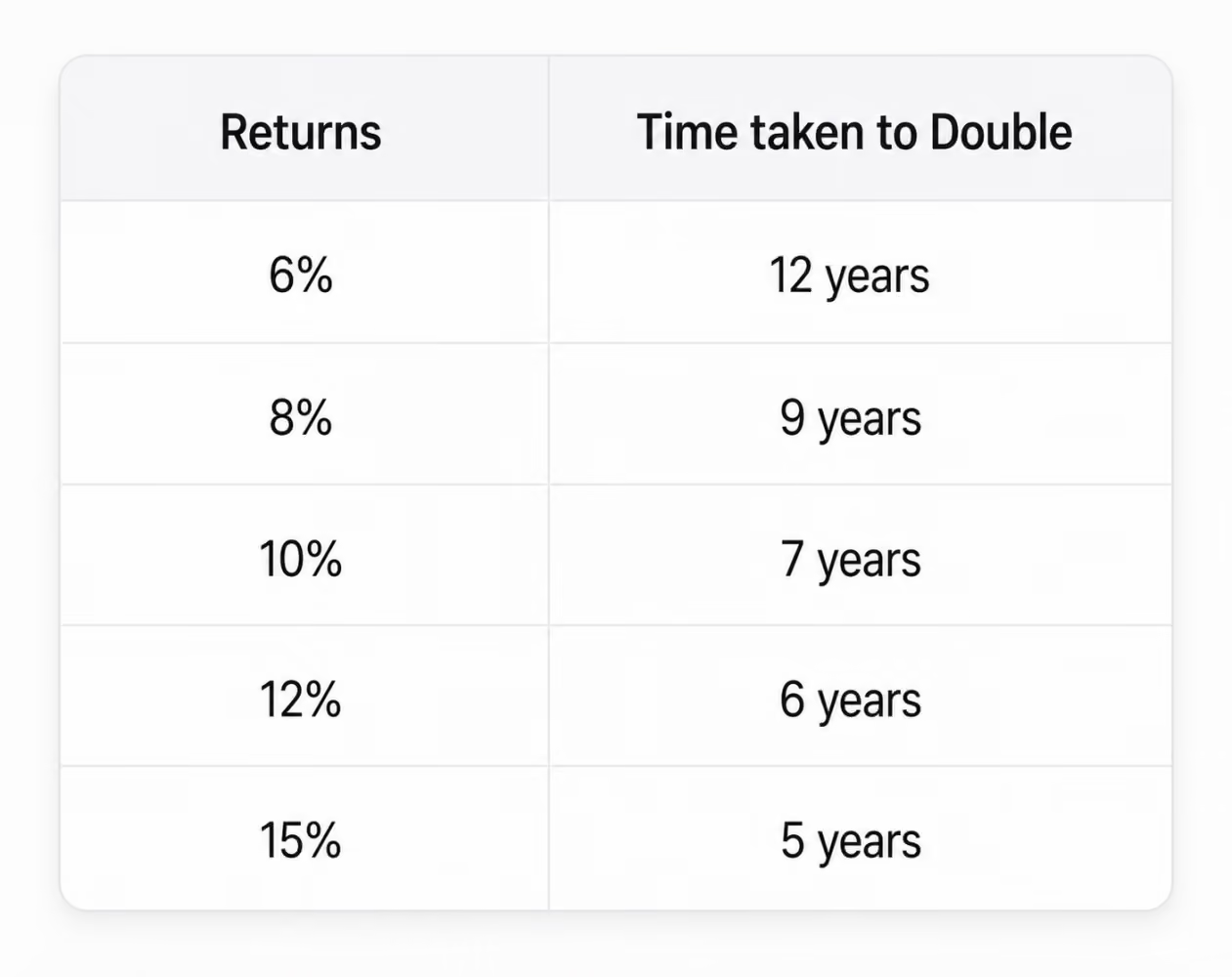
A simple way to think about this is the Rule of 72.
Divide 72 by your expected return to find out the time taken to double
A reasonable expectation from equities over the long term is around 12-15% which translates to a double every 5–6 years. (Last 25 year data for Nifty 50 TRI, shows that 75% of the times it has doubled in less than 6 years)
A Different Way to Think About Money
Building wealth isn't complicated.
It comes down to two things:
- How many doubles
- How long each takes
That’s it.
The hard part?
Staying invested long enough to experience it.
What should you do?
Think in doubles. Focus on the next one.
Happy investing as always :)


.jpg)