


RBI’s timely move on margin trading
.avif)
Borrowed-money investing through margin trading has become far more accessible in Indian equities. What used to be largely the domain of wealthy investors is now widely offered to retail clients via both discount and full-service brokers. As a result, margin activity has surged; NSE figures indicate that average daily outstanding positions under margin trading climbed sharply post-2020, touching around ₹1.16 lakh crore by April 2026.
For individual investors, margin trading offers clear upside but also heightened downside. It lets them build positions larger than their own capital would normally allow, so gains are magnified when markets move in their favour. However, the same leverage amplifies losses when prices move against them, potentially eroding their entire capital. In such phases, investors also face margin calls, forcing them either to infuse additional funds or liquidate holdings at a loss.
At the market level, the dynamics are similar. Leverage can support liquidity by enabling bigger positions and more active trading, which in turn can reduce price impact and lower transaction costs. But it also raises systemic vulnerability. Brokers extend margin lines against collateral, typically cash or pledged shares. When stock prices fall, collateral values drop, prompting brokers to demand more margin. If clients fail to meet these calls, brokers offload the margin-funded shares and/or sell the pledged securities. These forced sales intensify downward pressure on prices, which can trigger further margin calls and more forced selling, creating a feedback loop. Excessive leverage can therefore turn a routine correction into a much steeper market decline.
Because of these risks, regulators globally monitor margin trading closely, focusing on three core questions: How big is the margin book relative to the overall market? How does it behave under changing market conditions? And who ultimately provides the funding?
The first question helps gauge whether the risk is localised or systemic. If margin borrowing is small compared with total market size, forced liquidations are more likely to remain contained. But if leverage grows large, a price fall can generate broader stress. The second question concerns behaviour over the cycle. Margin balances typically expand in rising markets when sentiment is strong. The real stress test comes during corrections or volatility. If leverage is wound down gradually, the system can absorb shocks; if margin exposure stays elevated in choppy markets, even a modest negative move can set off margin calls and forced selling, deepening the downturn.
The third question is about the funding source. When brokers primarily use their own capital to finance margin, the risk is concentrated within the broking ecosystem. When bank credit is a major source, stress can migrate from capital markets into the banking sector. Hence, the origin of funds is as important as the absolute size of leverage.
On these three dimensions, India presents a mixed picture. In terms of size, the margin trading facility (MTF) book is still modest by global standards. As of April 30, 2026, daily outstanding under MTF was about ₹1.16 lakh crore, roughly 0.25 per cent of total market capitalisation, or about 0.5 per cent if only free-float is considered. This is below the US, where FINRA data show margin debt of about $1.30 trillion in April 2026, around 1.7–2 per cent of market value.
However, the timing aspect is more concerning. Since 2022, India’s MTF book has expanded sharply and remains elevated despite increased volatility. This raises the risk that a broad-based negative shock could be amplified through margin calls and forced liquidations. On the funding side, bank exposure is the key variable. RBI data indicate that bank lending to the capital market segment increased from ₹0.93 lakh crore in 2015 to ₹2.81 lakh crore in 2025. While this does not imply immediate instability, it underscores the need for regulators to monitor who is financing leverage, not just how much leverage exists.
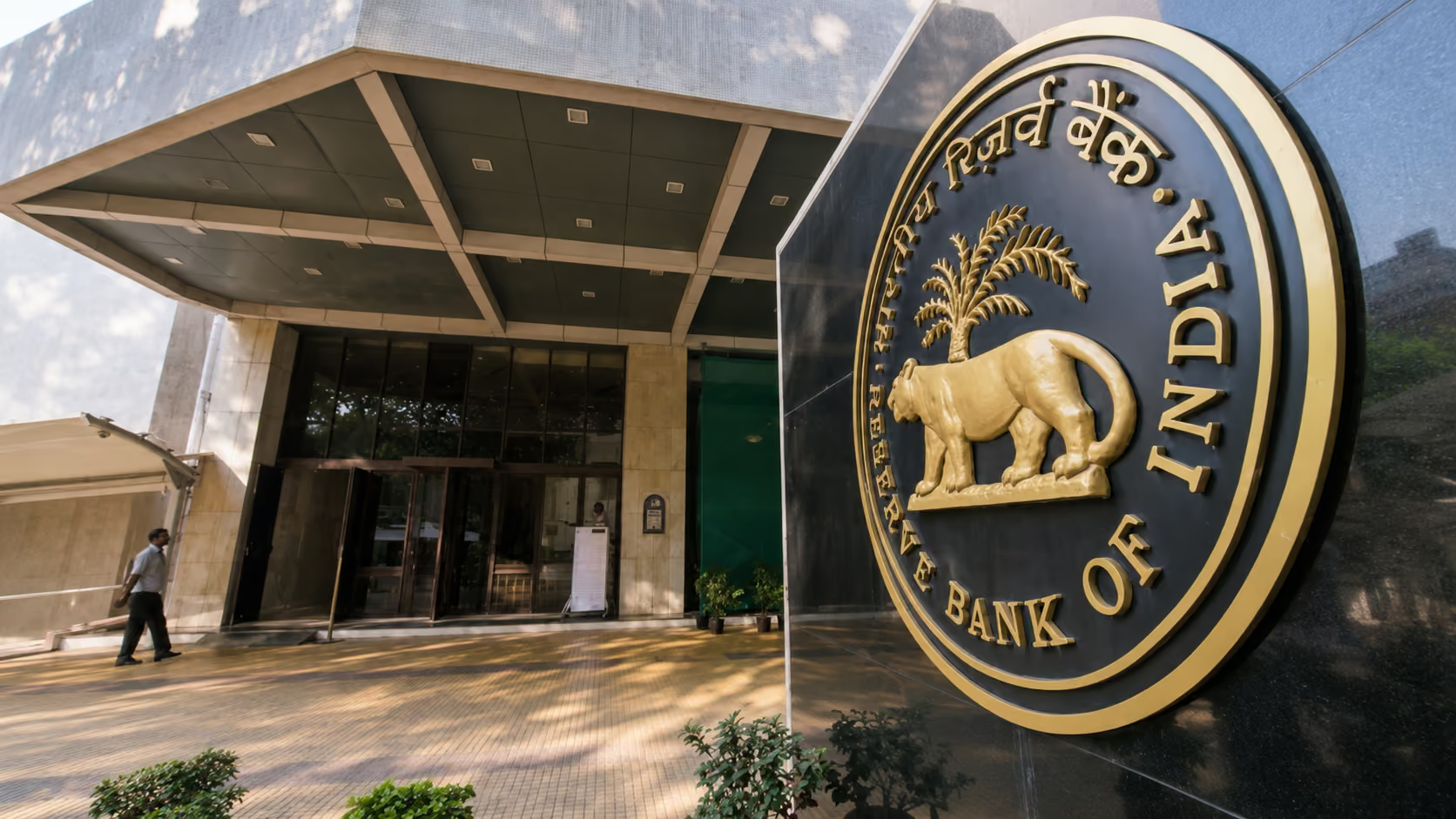
Despite the boom, margin trading in India operates under a regulatory framework. SEBI oversees the market-facing aspects through eligibility norms, daily mark-to-market processes, margin call protocols, exposure caps and volatility-linked margin requirements. The Reserve Bank of India’s recent measures target the funding side of the equation. By insisting that bank credit to brokers and other capital market intermediaries be fully secured, imposing steeper haircuts on equity collateral, capping banks’ exposure to capital markets, and disallowing bank funding of brokers’ proprietary trades, the RBI is working to limit the transmission of stock market stress into the banking system.
The core takeaway is that margin trading, in itself, need not be curtailed; it enhances liquidity and broadens investor options. But as the MTF book expands, the financial system must ensure that leverage is anchored in genuine capital and robust collateral. The RBI’s latest interventions are a timely move towards maintaining that balance.
Related Posts
.avif)
Big assets, bigger responsibilities: RBI's message to India’s largest non-banks
RBI’s new NBFC framework tightens norms for large and government-owned NBFCs, which can influence product design, risk assessment and partner selection for mutual fund distributors dealing with these entities or their debt.

The risks that come with US economy going from K to L-shaped
AI-driven Big Tech gains are propping up US consumption via a wealth effect concentrated in the richest households, but rising strain on lower-income consumers could quickly hurt markets if the AI trade reverses.


Big changes ahead? IRDAI to soon unveil insurance distribution reform paper
IRDAI’s upcoming distribution reform framework could reshape how intermediaries are incentivised and regulated, with greater emphasis on persistency, customer outcomes and principles-based oversight that MF Distributors must closely track for cross-sell and partnership strategies.

The five stages of a USMCA shakeup
Potential non-renewal of USMCA could disrupt North American trade, supply chains, and growth, indirectly affecting global markets that Indian MFD clients invest in.
Brokers hold out relief hope ahead of Reserve Bank of India's credit norms
RBI’s tighter bank credit norms for capital market intermediaries may still see last-minute relaxations, which could influence brokers’ funding capacity and, in turn, market liquidity for your clients.

Sebi panel weighs proposal to open physically settled commodity trades to FPIs
If implemented, Sebi’s proposal could draw more FPI participation into commodity derivatives, potentially boosting liquidity and product options that MFDs can position for clients seeking diversified risk exposure.

India is plotting a game-changer for RBI, banks, corporates, investors
A dedicated high-frequency index for India’s informal sector will give MF distributors sharper insight into real demand, employment and income trends that drive consumption-oriented funds and credit-focused strategies.

U.S. consumer confidence rises as gas prices fall, but economic outlook remains gloomy
For MFDs, modestly improving U.S. consumer confidence amid easing gas prices but lingering pessimism and a softening labor perception signals a still-fragile global backdrop for equity and debt allocations.
.avif)
Who gains in an AI-supercharged economy?
AI-driven productivity could shift long-term equity leadership from today’s tech builders to broader value and non-U.S. sectors, shaping how MFDs position client portfolios.

Lost money to cyber fraud? RBI's new rules offer compensation of up to ₹25,000
Stronger RBI-backed fraud protection and limited compensation up to ₹25,000 will reduce clients’ digital-banking risk, shaping how MFDs guide investors on using online channels safely.

ICICI Prudential launches Multi-Asset Active FoF: Key details for investors
This multi-asset FoF offers MFDs a single-product solution to position diversified, actively managed asset allocation across equity, debt, gold and silver for clients seeking smoother long-term outcomes.

India's ETF industry crosses ₹10 lakh crore AUM as ETF apps gain attention
Rapid growth in India’s ETF AUM and app-based access signals a structural shift toward low-cost passive products that MF distributors must factor into their product mix and client conversations.
.avif)
Sebi resolves over 5,500 investor complaints in May via SCORES platform
Faster and more effective complaint resolution on Sebi’s SCORES 2.0 platform strengthens investor protection and reinforces trust in regulated mutual fund and capital market intermediaries.


External shock risks rise as geopolitics, AI reshape global economy; near-term outlook uncertain: RBI governor
RBI’s latest Financial Stability Report signals a resilient banking system with record-low NPAs but warns MFDs to stay alert to rising external shocks and sectoral stress, especially in agriculture.
.avif)
RBI proposes opening term money market to NBFCs, companies
Broader access to the term money market for NBFCs, HFCs and companies can improve system liquidity and rate discovery, influencing short- to medium-term funding costs for your clients’ portfolios.


Inflation cools in biggest euro economies, easing rate hike urgency
Cooling inflation in major euro zone economies reduces immediate ECB rate hike pressure, which can influence global bond yields and overseas allocation decisions for Indian clients.

Smallcap funds beat all equity mutual fund categories over 3 months. Should investors change SIP strategy?
Smallcap funds’ sharp rebound and rich valuations mean distributors should guide clients towards disciplined SIP-based, long-horizon and asset-allocation-driven exposure rather than aggressive fresh bets or lump-sum entries.

JioBlackRock targets HNIs with launch of ₹10 lakh hybrid long-short fund
For mutual fund distributors, this SIF offers a new hybrid long-short option for affluent clients seeking volatility control and tax-efficient, outcome-oriented strategies beyond traditional MFs.
RBI’s timely move on margin trading
RBI’s tighter norms on bank funding of margin trading aim to contain contagion risk from leveraged equity positions to the banking system, which distributors should factor into risk conversations with clients.

AMFI reshuffle expected to see a marginal rise in large-cap cut-off, drop in mid-cap bar
AMFI’s latest market-cap reclassification will shift several names across large-, mid- and small-cap buckets, affecting MF distributors’ product positioning, model portfolios and category-wise allocation calls.


SIF assets grow nearly 7x in eight months, Hybrid Long-Short category leads industry expansion
SIFs, especially Hybrid Long-Short strategies, are emerging as a key new allocation option for affluent clients seeking risk-managed, tax-efficient returns—creating a growing advisory and distribution opportunity for MF distributors who upskill early.
SIF assets grow nearly 7x in eight months, Hybrid Long-Short category leads industry expansion
SIFs, especially Hybrid Long-Short strategies, are emerging as a key new allocation option for affluent clients seeking risk-managed, tax-efficient returns—creating a growing advisory and distribution opportunity for MF distributors who upskill early.
Who gains in an AI-supercharged economy?
AI-driven productivity could shift long-term equity leadership from today’s tech builders to broader value and non-U.S. sectors, shaping how MFDs position client portfolios.
Lost money to cyber fraud? RBI's new rules offer compensation of up to ₹25,000
Stronger RBI-backed fraud protection and limited compensation up to ₹25,000 will reduce clients’ digital-banking risk, shaping how MFDs guide investors on using online channels safely.
RBI’s timely move on margin trading
RBI’s tighter norms on bank funding of margin trading aim to contain contagion risk from leveraged equity positions to the banking system, which distributors should factor into risk conversations with clients.
Smallcap funds beat all equity mutual fund categories over 3 months. Should investors change SIP strategy?
Smallcap funds’ sharp rebound and rich valuations mean distributors should guide clients towards disciplined SIP-based, long-horizon and asset-allocation-driven exposure rather than aggressive fresh bets or lump-sum entries.
The risks that come with US economy going from K to L-shaped
AI-driven Big Tech gains are propping up US consumption via a wealth effect concentrated in the richest households, but rising strain on lower-income consumers could quickly hurt markets if the AI trade reverses.
.avif)
Your ARN number is now accepted for Meta ads verification
Meta now accepting ARN for ad verification lets MFDs run compliant, more credible campaigns on Facebook and Instagram, strengthening investor trust and regulatory alignment.
Big changes ahead? IRDAI to soon unveil insurance distribution reform paper
IRDAI’s upcoming distribution reform framework could reshape how intermediaries are incentivised and regulated, with greater emphasis on persistency, customer outcomes and principles-based oversight that MF Distributors must closely track for cross-sell and partnership strategies.
The five stages of a USMCA shakeup
Potential non-renewal of USMCA could disrupt North American trade, supply chains, and growth, indirectly affecting global markets that Indian MFD clients invest in.
Sebi resolves over 5,500 investor complaints in May via SCORES platform
Faster and more effective complaint resolution on Sebi’s SCORES 2.0 platform strengthens investor protection and reinforces trust in regulated mutual fund and capital market intermediaries.
RBI proposes opening term money market to NBFCs, companies
Broader access to the term money market for NBFCs, HFCs and companies can improve system liquidity and rate discovery, influencing short- to medium-term funding costs for your clients’ portfolios.
.avif)
Celebrity @ 5 lakh followers: SEBI’s draft ad code may slow influencer ads
SEBI’s draft ad code will slow and tighten influencer-led promotions for regulated products, pushing MFDs and brands toward more compliant, credibility-focused collaborations.
Inflation cools in biggest euro economies, easing rate hike urgency
Cooling inflation in major euro zone economies reduces immediate ECB rate hike pressure, which can influence global bond yields and overseas allocation decisions for Indian clients.
Sebi panel weighs proposal to open physically settled commodity trades to FPIs
If implemented, Sebi’s proposal could draw more FPI participation into commodity derivatives, potentially boosting liquidity and product options that MFDs can position for clients seeking diversified risk exposure.
AMFI reshuffle expected to see a marginal rise in large-cap cut-off, drop in mid-cap bar
AMFI’s latest market-cap reclassification will shift several names across large-, mid- and small-cap buckets, affecting MF distributors’ product positioning, model portfolios and category-wise allocation calls.
India's ETF industry crosses ₹10 lakh crore AUM as ETF apps gain attention
Rapid growth in India’s ETF AUM and app-based access signals a structural shift toward low-cost passive products that MF distributors must factor into their product mix and client conversations.
India is plotting a game-changer for RBI, banks, corporates, investors
A dedicated high-frequency index for India’s informal sector will give MF distributors sharper insight into real demand, employment and income trends that drive consumption-oriented funds and credit-focused strategies.
External shock risks rise as geopolitics, AI reshape global economy; near-term outlook uncertain: RBI governor
RBI’s latest Financial Stability Report signals a resilient banking system with record-low NPAs but warns MFDs to stay alert to rising external shocks and sectoral stress, especially in agriculture.
Big assets, bigger responsibilities: RBI's message to India’s largest non-banks
RBI’s new NBFC framework tightens norms for large and government-owned NBFCs, which can influence product design, risk assessment and partner selection for mutual fund distributors dealing with these entities or their debt.
U.S. consumer confidence rises as gas prices fall, but economic outlook remains gloomy
For MFDs, modestly improving U.S. consumer confidence amid easing gas prices but lingering pessimism and a softening labor perception signals a still-fragile global backdrop for equity and debt allocations.
JioBlackRock targets HNIs with launch of ₹10 lakh hybrid long-short fund
For mutual fund distributors, this SIF offers a new hybrid long-short option for affluent clients seeking volatility control and tax-efficient, outcome-oriented strategies beyond traditional MFs.