


The five stages of a USMCA shakeup

On July 1, North American economic ties may enter a new phase. The United States is expected to formally declare that it will not renew the United States-Mexico-Canada Agreement (USMCA), triggering what could become a negotiation process stretching up to a decade over the pact’s future.
This announcement does not immediately end USMCA; termination would only occur if the three countries fail to extend the agreement over the next ten years. Because of that, some observers argue that the short-term impact will be limited. In practice, however, the three governments will be locked into lengthy talks to try to preserve the deal. Prolonged uncertainty around such tightly linked economies—when they should be coordinating on strategic issues—can undermine growth and geopolitical stability.
What appears to be a routine deadline could therefore shape economic and political outcomes for many years. The following outlines how each phase of the process could affect the regional and global economy.
Initially, business would largely continue as normal. Despite heavy tariffs already in place and US President Donald Trump’s claim that the United States would be better off without USMCA, the three economies remain highly interdependent and reliant on the agreement. Missing the July 1 renewal date is unlikely to halt discussions: Mexico and Canada have repeatedly shown they will tolerate pressure to keep markets open. Mexico has already entered formal bilateral talks with Washington, and Canada is pushing for a swift renewal.
But after a few months, the reality would set in. Years of talks just to preserve the existing framework could prove unproductive, distracting, and damaging. The standard negotiation track may leave Canada and Mexico with limited bargaining power, while repeated threats of US withdrawal could derail substantive discussions. Extended ambiguity might also prompt companies to reconfigure sourcing and supply chains.
As negotiations drag, tariffs would remain a key pressure tool. Operating with a more aggressive approach, Trump could respond to slow progress by escalating trade measures. Options include broadening Section 232 tariffs, opening new Section 232 probes, tightening rules for USMCA eligibility, or imposing Section 301 tariffs even on products covered by USMCA. A change in Section 301 alone could sharply increase duties. If all imports from Canada and Mexico were hit with an extra 25 percent tariff—similar to rates previously signaled under the International Emergency Economic Powers Act before USMCA exemptions—it would add roughly $70 billion in new tariffs. Even without higher Section 301 rates, existing Section 232 duties have already strained ties, with Ottawa and Mexico City prioritizing the removal of steel and aluminum tariffs. Any further 232 actions would heighten tensions and raise input costs for firms.
Canada and Mexico could respond with their own retaliatory tariffs, though it is uncertain whether they would do so. To date, both have tended to accommodate US pressure to safeguard market access and relative stability. If the pressure intensifies, they may instead accelerate efforts to diversify trade relationships and reduce reliance on the US market.
As this drags on, external trade agreements would gain importance. The trilateral structure could gradually give way to separate bilateral deals. Trump has long favored bilateral arrangements and could pursue a standalone pact with Mexico, which has managed recent frictions with Washington somewhat better than Canada. Meanwhile, Canada and Mexico could deepen their own cooperation, building on their 2025–2028 action plan to craft a bilateral agreement. Still, any bilateral configuration would be weaker than a unified trilateral framework, likely pushing all three to look more actively to other partners. Canada is already broadening trade talks globally, and Mexico has advanced negotiations with the European Union and Brazil.
In such a fragmented scenario, China would likely benefit significantly. Canada has already strengthened its economic ties with China, including ongoing talks to expand Canadian exports and reduce tariffs. Mexico, under US pressure, has cut back on Chinese imports, but without strong incentives to maintain that stance, it would have more reason to turn again to China for components, investment, and low-cost products. The absence of a cohesive North American front would also give Beijing more room to reroute exports and circumvent rules of origin.
After a few years, the economic fallout would become more visible. The auto industry—North America’s largest traded sector—illustrates the risk. It has already seen tariffs jump by nearly 625 percent due to Section 232 measures, contributing to a 10 percent decline in imports and a 19 percent drop in exports in the year after Liberation Day compared with the prior year. Even with high USMCA utilization, the sector is weakened and would be highly exposed if the underlying free trade framework erodes.
Even without further tariff hikes, prolonged negotiations carry their own costs. Supply chains are typically planned on a thirty-year horizon, not five, and persistent uncertainty can deter capital expenditure and expansion. At the same time, energy spent on arguing over whether to keep the agreement would crowd out essential discussions on technology development, competition with Chinese electric vehicles, and broader competitiveness. A destabilized USMCA would send shockwaves through the wider economy, weighing on growth and employment across industries.
Over the longer term, uncertainty could become entrenched. By the end of the Trump administration, the US, Canadian, and Mexican economies could be weakened by repeated negotiation rounds, tariff cycles, and offshoring. Trilateral coordination on key global trade issues might erode, with the region stuck in a loop of renewal talks. The next US administration would then face a choice: continue the same pattern or commit to forging a new, more durable arrangement.
From this disruption, a new trilateral framework or a set of bilateral deals could eventually emerge. That outcome is not inherently negative. North America might ultimately design an agreement better aligned with current realities—capable of addressing China, artificial intelligence, labor and environmental standards, and supply chain shocks. But there is also the risk that years spent merely keeping the existing pact alive, rather than improving it, will be wasted. In that case, the three economies could be left limping along under an outdated agreement that no longer reflects economic realities.
These phases resemble the classic five stages of grief after a breakup. First is denial, as policymakers tell themselves the relationship can continue unchanged. Then comes anger, manifested through tariffs and countermeasures. Bargaining follows, with governments seeking side deals and firms diversifying their operations. Eventually, the mounting economic costs become impossible to ignore. Finally, a decision must be made: accept a more difficult new status quo or rebuild a stronger partnership.
North America’s free trade area is not disappearing, but it is likely evolving. The precise end state is uncertain, yet two points are clear: ongoing negotiations will bring their own economic strain, and the relationship will almost certainly be transformed. Some partnerships survive prolonged uncertainty, but very few emerge from it without change.
Madeline Chalecki is an assistant director at the Atlantic Council’s GeoEconomics Center, where she oversees work on trade policy, tariffs, and supply chains, including the Trump Tariff Tracker.
Related Posts
.avif)
Big assets, bigger responsibilities: RBI's message to India’s largest non-banks
RBI’s new NBFC framework tightens norms for large and government-owned NBFCs, which can influence product design, risk assessment and partner selection for mutual fund distributors dealing with these entities or their debt.
.avif)
Sebi resolves over 5,500 investor complaints in May via SCORES platform
Faster and more effective complaint resolution on Sebi’s SCORES 2.0 platform strengthens investor protection and reinforces trust in regulated mutual fund and capital market intermediaries.

.avif)
RBI proposes opening term money market to NBFCs, companies
Broader access to the term money market for NBFCs, HFCs and companies can improve system liquidity and rate discovery, influencing short- to medium-term funding costs for your clients’ portfolios.

The risks that come with US economy going from K to L-shaped
AI-driven Big Tech gains are propping up US consumption via a wealth effect concentrated in the richest households, but rising strain on lower-income consumers could quickly hurt markets if the AI trade reverses.

India's ETF industry crosses ₹10 lakh crore AUM as ETF apps gain attention
Rapid growth in India’s ETF AUM and app-based access signals a structural shift toward low-cost passive products that MF distributors must factor into their product mix and client conversations.
.avif)
Your ARN number is now accepted for Meta ads verification
Meta now accepting ARN for ad verification lets MFDs run compliant, more credible campaigns on Facebook and Instagram, strengthening investor trust and regulatory alignment.

SIF assets grow nearly 7x in eight months, Hybrid Long-Short category leads industry expansion
SIFs, especially Hybrid Long-Short strategies, are emerging as a key new allocation option for affluent clients seeking risk-managed, tax-efficient returns—creating a growing advisory and distribution opportunity for MF distributors who upskill early.
.avif)
Who gains in an AI-supercharged economy?
AI-driven productivity could shift long-term equity leadership from today’s tech builders to broader value and non-U.S. sectors, shaping how MFDs position client portfolios.

JioBlackRock targets HNIs with launch of ₹10 lakh hybrid long-short fund
For mutual fund distributors, this SIF offers a new hybrid long-short option for affluent clients seeking volatility control and tax-efficient, outcome-oriented strategies beyond traditional MFs.
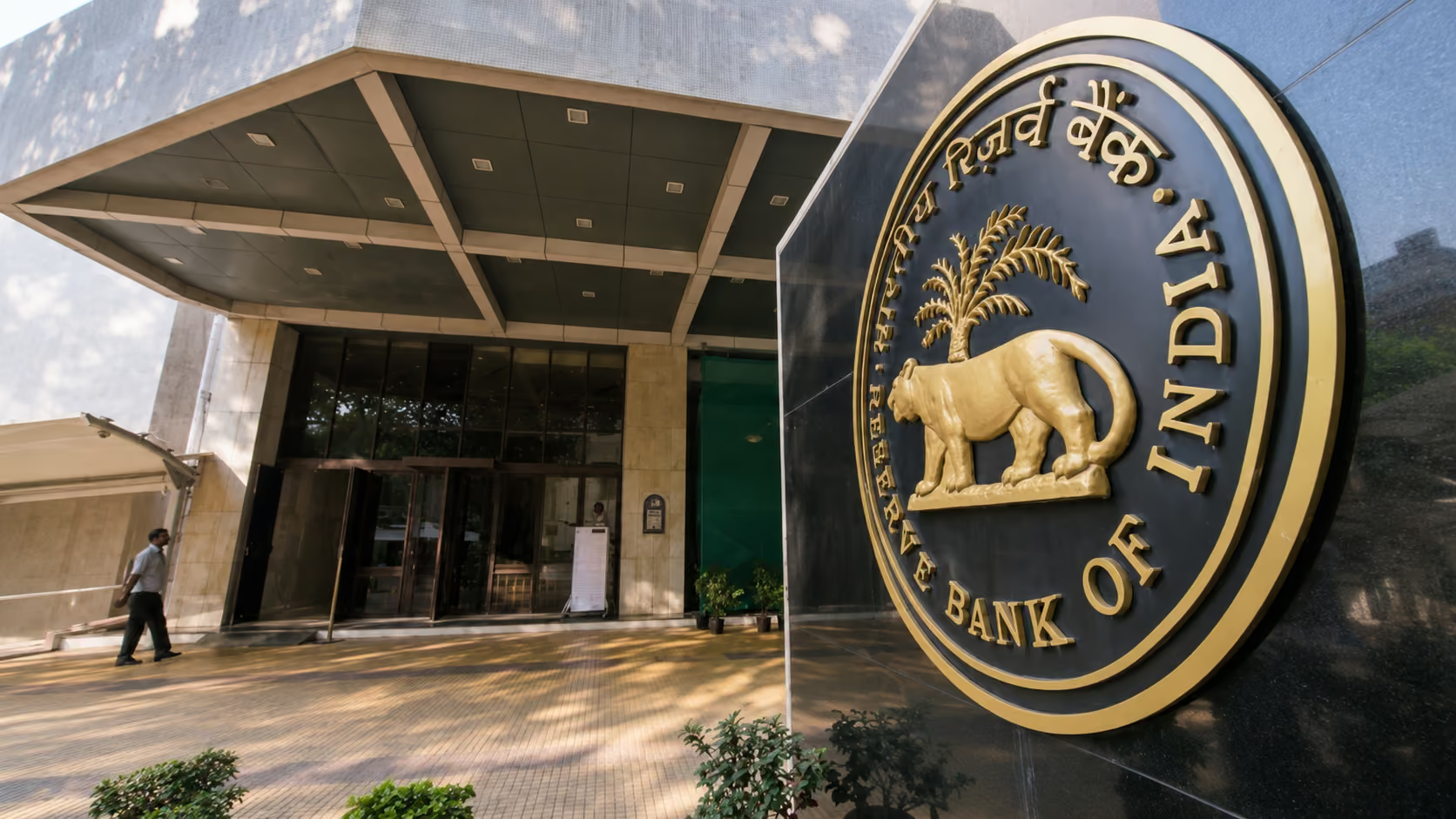
Brokers hold out relief hope ahead of Reserve Bank of India's credit norms
RBI’s tighter bank credit norms for capital market intermediaries may still see last-minute relaxations, which could influence brokers’ funding capacity and, in turn, market liquidity for your clients.

India is plotting a game-changer for RBI, banks, corporates, investors
A dedicated high-frequency index for India’s informal sector will give MF distributors sharper insight into real demand, employment and income trends that drive consumption-oriented funds and credit-focused strategies.


U.S. consumer confidence rises as gas prices fall, but economic outlook remains gloomy
For MFDs, modestly improving U.S. consumer confidence amid easing gas prices but lingering pessimism and a softening labor perception signals a still-fragile global backdrop for equity and debt allocations.

.avif)
Celebrity @ 5 lakh followers: SEBI’s draft ad code may slow influencer ads
SEBI’s draft ad code will slow and tighten influencer-led promotions for regulated products, pushing MFDs and brands toward more compliant, credibility-focused collaborations.
.avif)
RBI’s timely move on margin trading
RBI’s tighter norms on bank funding of margin trading aim to contain contagion risk from leveraged equity positions to the banking system, which distributors should factor into risk conversations with clients.

Sebi panel weighs proposal to open physically settled commodity trades to FPIs
If implemented, Sebi’s proposal could draw more FPI participation into commodity derivatives, potentially boosting liquidity and product options that MFDs can position for clients seeking diversified risk exposure.

Big changes ahead? IRDAI to soon unveil insurance distribution reform paper
IRDAI’s upcoming distribution reform framework could reshape how intermediaries are incentivised and regulated, with greater emphasis on persistency, customer outcomes and principles-based oversight that MF Distributors must closely track for cross-sell and partnership strategies.

External shock risks rise as geopolitics, AI reshape global economy; near-term outlook uncertain: RBI governor
RBI’s latest Financial Stability Report signals a resilient banking system with record-low NPAs but warns MFDs to stay alert to rising external shocks and sectoral stress, especially in agriculture.

Smallcap funds beat all equity mutual fund categories over 3 months. Should investors change SIP strategy?
Smallcap funds’ sharp rebound and rich valuations mean distributors should guide clients towards disciplined SIP-based, long-horizon and asset-allocation-driven exposure rather than aggressive fresh bets or lump-sum entries.


ICICI Prudential launches Multi-Asset Active FoF: Key details for investors
This multi-asset FoF offers MFDs a single-product solution to position diversified, actively managed asset allocation across equity, debt, gold and silver for clients seeking smoother long-term outcomes.

Inflation cools in biggest euro economies, easing rate hike urgency
Cooling inflation in major euro zone economies reduces immediate ECB rate hike pressure, which can influence global bond yields and overseas allocation decisions for Indian clients.

AMFI reshuffle expected to see a marginal rise in large-cap cut-off, drop in mid-cap bar
AMFI’s latest market-cap reclassification will shift several names across large-, mid- and small-cap buckets, affecting MF distributors’ product positioning, model portfolios and category-wise allocation calls.
India's ETF industry crosses ₹10 lakh crore AUM as ETF apps gain attention
Rapid growth in India’s ETF AUM and app-based access signals a structural shift toward low-cost passive products that MF distributors must factor into their product mix and client conversations.
AMFI reshuffle expected to see a marginal rise in large-cap cut-off, drop in mid-cap bar
AMFI’s latest market-cap reclassification will shift several names across large-, mid- and small-cap buckets, affecting MF distributors’ product positioning, model portfolios and category-wise allocation calls.
Big assets, bigger responsibilities: RBI's message to India’s largest non-banks
RBI’s new NBFC framework tightens norms for large and government-owned NBFCs, which can influence product design, risk assessment and partner selection for mutual fund distributors dealing with these entities or their debt.
External shock risks rise as geopolitics, AI reshape global economy; near-term outlook uncertain: RBI governor
RBI’s latest Financial Stability Report signals a resilient banking system with record-low NPAs but warns MFDs to stay alert to rising external shocks and sectoral stress, especially in agriculture.
Brokers hold out relief hope ahead of Reserve Bank of India's credit norms
RBI’s tighter bank credit norms for capital market intermediaries may still see last-minute relaxations, which could influence brokers’ funding capacity and, in turn, market liquidity for your clients.
Who gains in an AI-supercharged economy?
AI-driven productivity could shift long-term equity leadership from today’s tech builders to broader value and non-U.S. sectors, shaping how MFDs position client portfolios.
SIF assets grow nearly 7x in eight months, Hybrid Long-Short category leads industry expansion
SIFs, especially Hybrid Long-Short strategies, are emerging as a key new allocation option for affluent clients seeking risk-managed, tax-efficient returns—creating a growing advisory and distribution opportunity for MF distributors who upskill early.
Smallcap funds beat all equity mutual fund categories over 3 months. Should investors change SIP strategy?
Smallcap funds’ sharp rebound and rich valuations mean distributors should guide clients towards disciplined SIP-based, long-horizon and asset-allocation-driven exposure rather than aggressive fresh bets or lump-sum entries.
The risks that come with US economy going from K to L-shaped
AI-driven Big Tech gains are propping up US consumption via a wealth effect concentrated in the richest households, but rising strain on lower-income consumers could quickly hurt markets if the AI trade reverses.
Big changes ahead? IRDAI to soon unveil insurance distribution reform paper
IRDAI’s upcoming distribution reform framework could reshape how intermediaries are incentivised and regulated, with greater emphasis on persistency, customer outcomes and principles-based oversight that MF Distributors must closely track for cross-sell and partnership strategies.
India is plotting a game-changer for RBI, banks, corporates, investors
A dedicated high-frequency index for India’s informal sector will give MF distributors sharper insight into real demand, employment and income trends that drive consumption-oriented funds and credit-focused strategies.

Lost money to cyber fraud? RBI's new rules offer compensation of up to ₹25,000
Stronger RBI-backed fraud protection and limited compensation up to ₹25,000 will reduce clients’ digital-banking risk, shaping how MFDs guide investors on using online channels safely.
Your ARN number is now accepted for Meta ads verification
Meta now accepting ARN for ad verification lets MFDs run compliant, more credible campaigns on Facebook and Instagram, strengthening investor trust and regulatory alignment.
The five stages of a USMCA shakeup
Potential non-renewal of USMCA could disrupt North American trade, supply chains, and growth, indirectly affecting global markets that Indian MFD clients invest in.
ICICI Prudential launches Multi-Asset Active FoF: Key details for investors
This multi-asset FoF offers MFDs a single-product solution to position diversified, actively managed asset allocation across equity, debt, gold and silver for clients seeking smoother long-term outcomes.
RBI’s timely move on margin trading
RBI’s tighter norms on bank funding of margin trading aim to contain contagion risk from leveraged equity positions to the banking system, which distributors should factor into risk conversations with clients.
RBI proposes opening term money market to NBFCs, companies
Broader access to the term money market for NBFCs, HFCs and companies can improve system liquidity and rate discovery, influencing short- to medium-term funding costs for your clients’ portfolios.
Sebi panel weighs proposal to open physically settled commodity trades to FPIs
If implemented, Sebi’s proposal could draw more FPI participation into commodity derivatives, potentially boosting liquidity and product options that MFDs can position for clients seeking diversified risk exposure.
Inflation cools in biggest euro economies, easing rate hike urgency
Cooling inflation in major euro zone economies reduces immediate ECB rate hike pressure, which can influence global bond yields and overseas allocation decisions for Indian clients.
U.S. consumer confidence rises as gas prices fall, but economic outlook remains gloomy
For MFDs, modestly improving U.S. consumer confidence amid easing gas prices but lingering pessimism and a softening labor perception signals a still-fragile global backdrop for equity and debt allocations.
Sebi resolves over 5,500 investor complaints in May via SCORES platform
Faster and more effective complaint resolution on Sebi’s SCORES 2.0 platform strengthens investor protection and reinforces trust in regulated mutual fund and capital market intermediaries.